
29 September 2026
Confidence in the real estate investment market – tempered by regulation
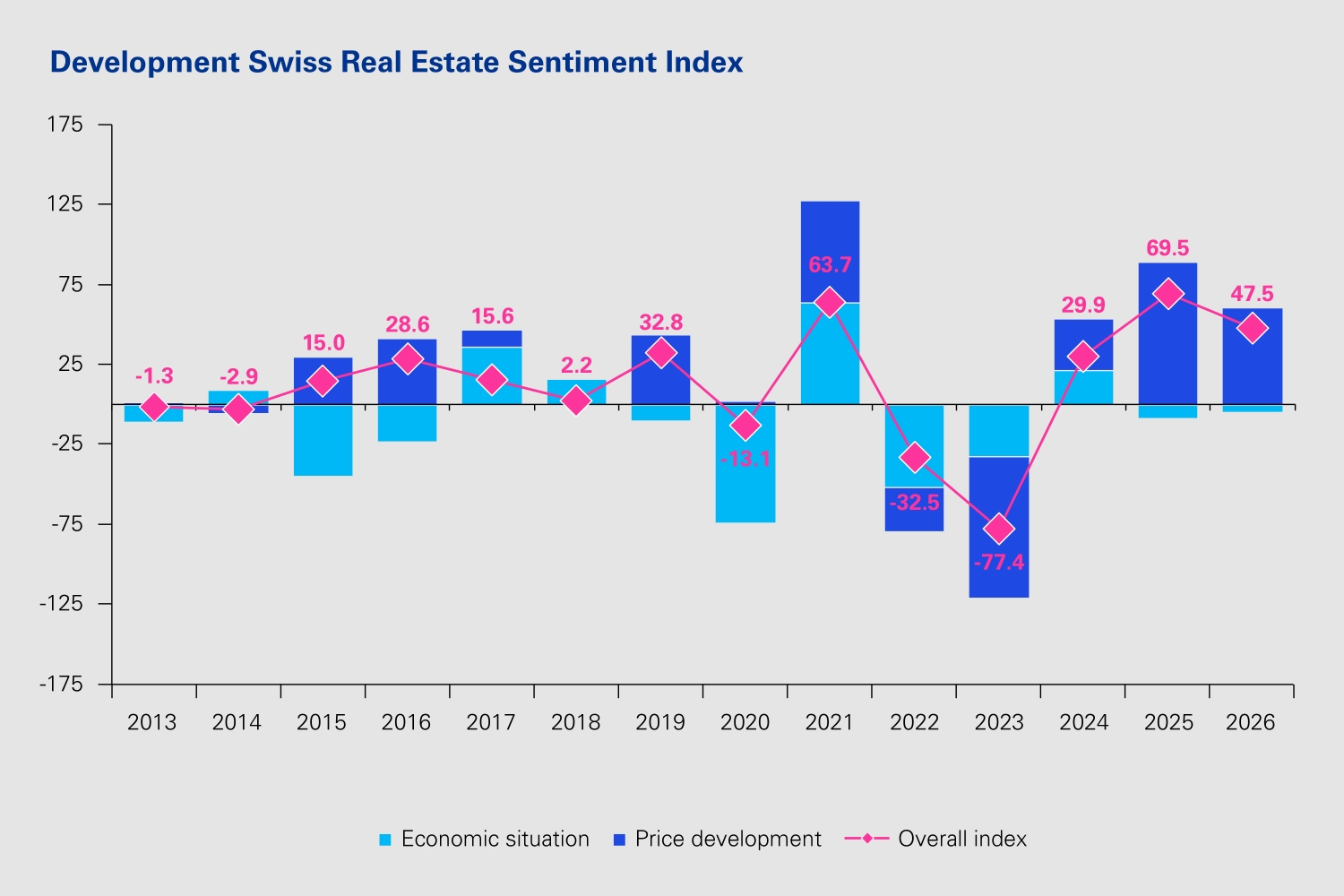
- At +47.5 points, the Swiss Real Estate Sentiment Index signals a high level of confidence in the real estate investment market.
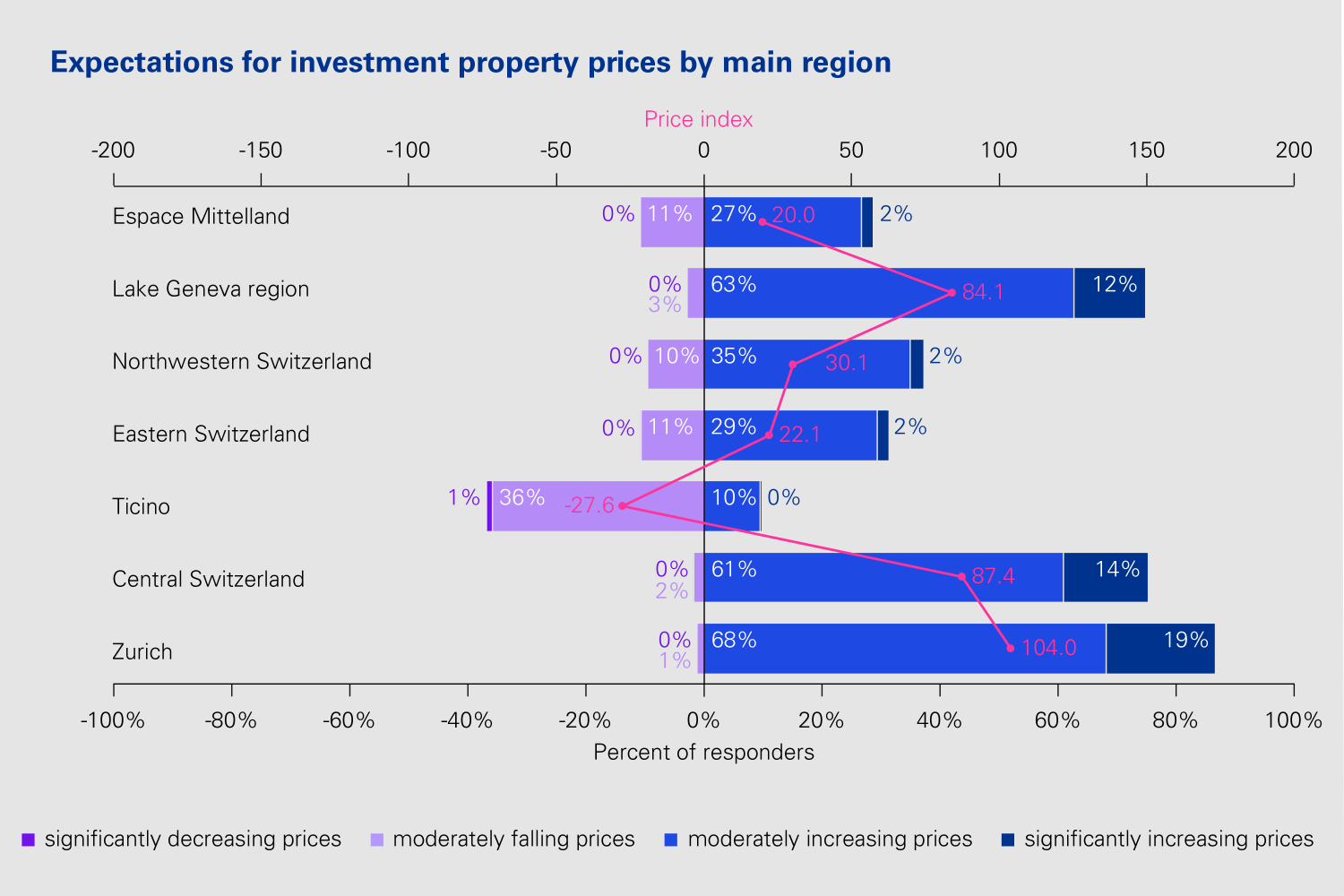
- Price expectations remain positive across all location categories, but have lost momentum compared to the record year of 2025.
- 90 percent of respondents expect residential real estate prices to rise. At the same time, suitable investment opportunities are becoming increasingly scarce.
- Zurich, Central Switzerland and the Lake Geneva region show the greatest price potential.
- Political and regulatory conditions are slowing development projects and remain the biggest market risk.
The Swiss real estate sector remains optimistic about the future. This is reflected in the survey results of the Swiss Real Estate Sentiment Index (sresi®), which captures industry expectations for price and economic developments over the next 12 months. After reaching a record high of +69.5 points last year, the aggregated index stands at +47.5 points in 2026. The decline reflects more moderate price expectations, while the assessment of economic development in Switzerland remains slightly negative.
Positive price expectations with slowing momentum
Compared with the previous year’s all-time high of +89.0 points, the sub-index “Price development” fell by 28.3 points to +60.7 points. Nevertheless, roughly 62 percent of respondents expect prices to increase slightly or significantly over the next twelve months. The expectations remain positive across all participant groups, most notably among pension funds (+72.7 points), real estate companies (+72.3 points) and real estate funds (+65.5 points).
“Investment pressure remains high in the Swiss real estate market. Further price increases can be expected, particularly in the residential segment, though price momentum is likely to be limited as acquisition yields are already low” says Beat Seger, Real Estate Expert at KPMG Switzerland.
Focus on residential properties and urban centers
While price expectations for residential real estate remain high at +109.8 points, they are below last year’s all-time high of +131.0 points. Around 90 percent of respondents expect prices to rise. While prices for office (-2.7 points) and commercial properties (-4.1 points) are expected to remain relatively stable, expectations for retail properties (-40.2 points) are negative. Special-purpose properties remain slightly positive at +13.2 points.
A clear picture also emerges across location categories: Price expectations are particularly high for urban centers (+88.5 points), followed by secondary centers and agglomerations (+76.1 points). Peripheral locations remain positive at +8.8 points but are losing price potential.
Economic centers remain attractive
The strongest price increases are once again expected in Zurich (+104.0 points), Central Switzerland (+87.4 points) and the Lake Geneva region (+84.1 points). 87 percent of respondents expect rising prices in Zurich, while the figure for both Central Switzerland and the Lake Geneva region is 75 percent. At -7.9 points, Lugano is the only economic center with negative price expectations. The Ticino region has also been in negative territory since the inception of the survey.
Subdued outlook for economic growth
Expectations for Swiss economic growth remain slightly negative at -5.0 points and are virtually unchanged compared to the previous year (2025: -8.4 points). Only real estate funds (+1.7 points) and insurers (+0.1 points) expect growth to be slightly positive. Real estate companies, pension funds, developers and appraisers anticipate a slight deterioration.
“The real estate investment market remains robust despite subdued economic expectations. The lower overall index therefore does not indicate a shift in sentiment but rather a normalization following the exceptionally strong previous year,” says Beat Seger.
Residential: Supply shortage intensifies
The supply index for residential properties fell from -107.9 to -122.3 points, indicating that the market participants see a pronounced shortage of supply. Around 84 percent expect a moderate to severe shortage of suitable investment opportunities in the residential segment, five percentage points more than in 2025. Office, commercial and special-purpose properties are considered to be in limited supply. Retail properties are the only segment where the supply is considered sufficient at +8.1 points.
Residential properties remain the preferred asset class
Investment preferences remain largely unchanged. On average, respondents would allocate 64 percent of a hypothetical CHF 100 million investment to residential properties. This figure is 73 percent for pension funds and 70 percent among developers. Office properties account for 13 percent of the total investment volume, commercial properties for 12 percent, special-purpose properties for 7 percent and retail properties for 4 percent.
Regulation as the biggest cause for concern
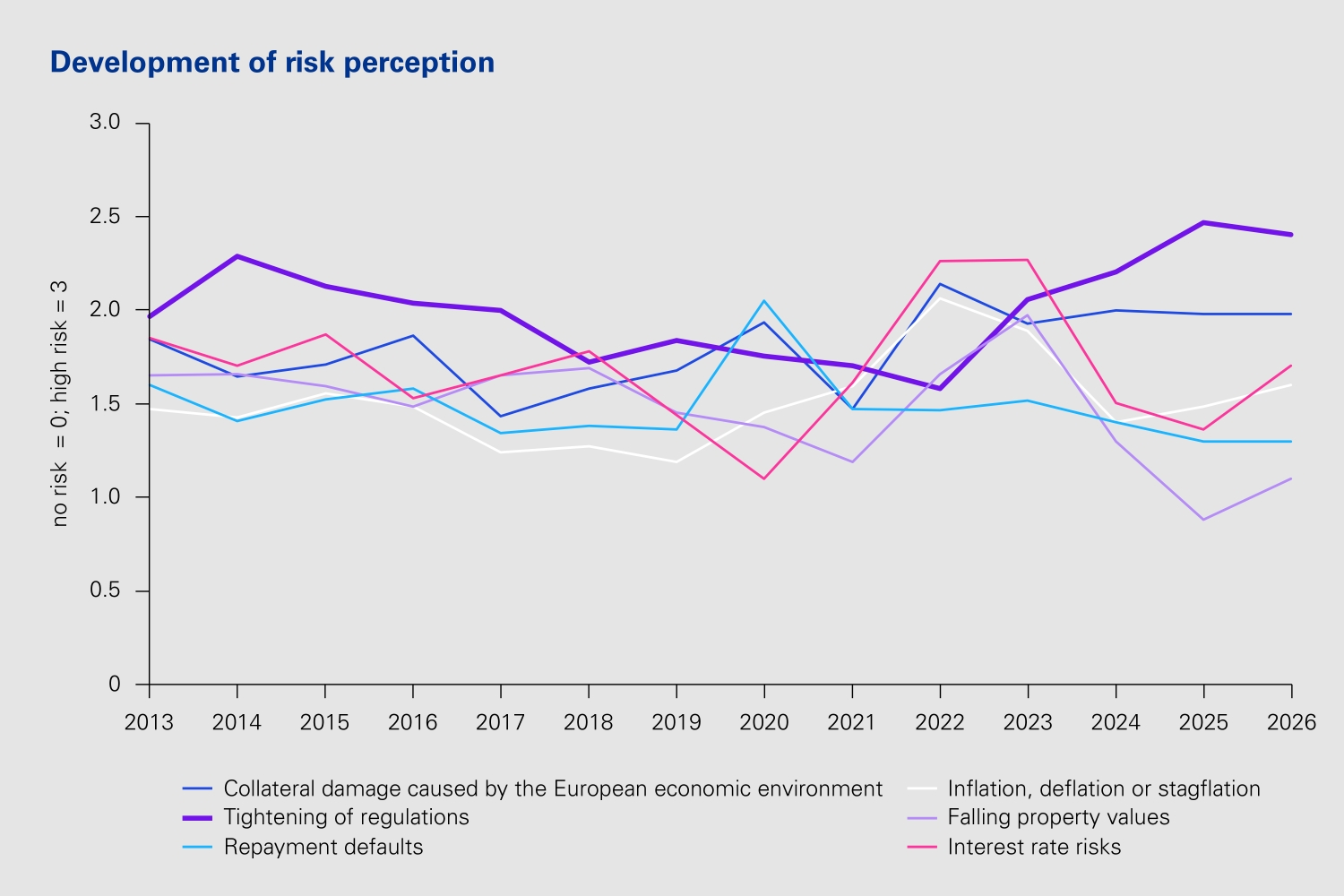
The risk index rose slightly from 1.58 to 1.67 points, reaching its third-highest level in the past ten years. Tighter regulation remains the biggest risk to the Swiss real estate investment market, scoring 2.4 out of 3 points. Potential effects of the European economic environment rank second, at 2.0 points. Interest rate risk has moved into third place for the first time since 2024 at 1.7 points. Declining property values continue to be perceived as the lowest risk.
Political conditions shape the industry
The survey underlines the strong influence of political decisions on the real estate market. 94 percent of respondents believe that the adoption of the sustainability initiative “No to a Switzerland with 10 million!” would have had a negative or strongly negative impact on Switzerland as a business location. 95 percent of respondents would have expected negative consequences for the commercial real estate segment had the initiative been adopted.
Objections and building permit procedures are considered key obstacles to development projects, new construction, and renovations: 97 percent of respondents believe that they have a significant impact. Political and regulatory conditions are also seen as having a noticeable or strong impact by 94 percent of respondents, while 64 percent cite the construction industry’s capacity as an important influencing factor.
87 percent of respondents believe that the adverse anticipatory effect of a building and zoning ordinance that has not yet been adopted creates considerable planning uncertainty. “Planning certainty is a basic prerequisite for investment. Without a binding regulatory framework, projects are delayed, become more expensive or are not implemented at all” says Beat Seger.
A tightening of the Lex Koller legislation could also have a noticeable impact on the market. 63 percent see a risk that listed real estate companies and real estate funds could be delisted from the stock market. This, among other factors, would affect liquidity in the transaction market, according to 61 percent of respondents. 61 percent expect capital to shift into alternative asset classes or markets. This could significantly impair the country’s supply of residential and commercial space.
For more information and the detailed study with interactive dashboards, please go to: www.kpmg.ch/sresi
Methodology:
The KPMG Swiss Real Estate Sentiment Index (sresi®) serves as a leading indicator of anticipated developments on the Swiss real estate investment market. The main index is compiled based on assessments of economic developments and price trends on the real estate investment market. The aggregated index reflects respondents’ assessments of the general economic situation (weighted at 20 percent) and the real estate price trend (weighted at 80 percent). The sub-indices express the opinions of market players with respect to individual market and use categories.
This data was first collected in 2012, and the survey is repeated every year. Over 370 representatives of the Swiss real estate investment market took part in the 2026 survey. They represent an investment and appraisal volume in excess of CHF 360 billion. The survey was conducted between 16 June and 24 August 2026. The participants comprise institutional investors (57 percent), professional or private investors (12 percent), appraisers (21 percent) and real estate developers (10 percent).
For further information, please contact:

About KPMG Switzerland
KPMG Switzerland is a leading service provider in the areas of Audit, Tax & Legal, and Advisory & Consulting, with more than 2,600 employees. We operate in 10 locations throughout Switzerland and one in Liechtenstein. Our clients benefit from our tailored solutions and our strategic alliances with technology partners that support our audit and non-audit services alike. In the 2025 financial year, KPMG Switzerland generated net sales of CHF 561.6 million. We operate in 138 countries and territories with more than 276,000 partners and employees working in member firms around the world.