To remain competitive, compliance activities within the financial sector must be organised in an increasingly efficient, flexible and cost-effective manner.

      Our experts, who have extensive industry experience, provide you with comprehensive support: KPMG FS Regulatory & Compliance advises banks, insurance companies and securities and financial services institutions on establishing, reorganising and further developing their compliance functions.

      auto_stories

      AI and machine learning: how RegTech companies are supporting the financial sector with regulatory requirements


      Shaping compliance transformation

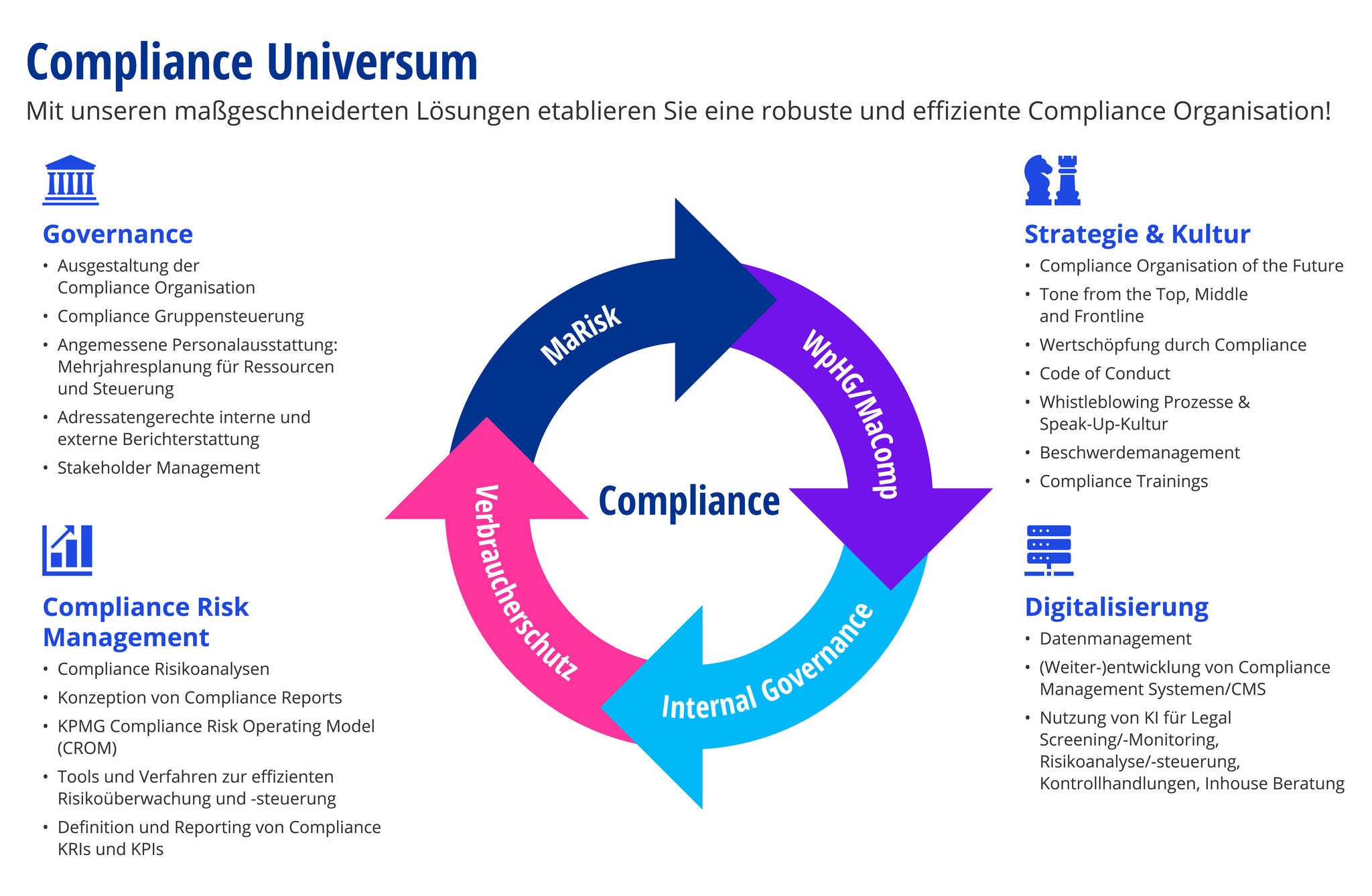
      Take advantage of our expertise in compliance management across the four key areas:

      • Governance
      • Strategy & Culture
      • Compliance Risk Management
      • Digitalisation

      We align the key elements of an effective compliance framework.

      The following services will help you successfully implement your compliance and risk transformation:


      Governance that provides direction, and compliance that delivers results

       
      Modern governance should provide clarity in an increasingly complex environment – but how can it be implemented efficiently in practice? Our experts develop governance structures that make risks manageable, clarify responsibilities and strengthen the ability to steer the organisation.

      One thing is clear: financial institutions are under growing pressure to transform. Regulatory requirements are increasing, business models are changing and digitalisation is accelerating. Governance therefore has to do more today than simply define roles and responsibilities. It creates transparency, supports effective governance [PH1] and enables the management of risks, processes and decisions.

      Compliance Management: Robust governance as the foundation for future resilience

      In practice, however, fragmented system landscapes, inconsistent interfaces, rising data requirements and complex reporting processes make effective management difficult. At the same time, supervisory authorities expect robust governance structures, clear responsibilities and traceability.

      • For this reason, only an optimised governance function can serve as a sound foundation for the compliance function of the future: it enables clear decision-making pathways, reliable data, efficient control mechanisms and organisational resilience. In this way, institutions can keep regulatory risks under control and strengthen their ability to act.

      We combine regulatory expertise, organisational design, process expertise and technological know-how to further develop governance models, compliance structures and operating models in a way that is fit for the future. 

      An overview of our services:

      •  Governance design that creates transparency: We develop models that clearly define roles, responsibilities and decision-making processes — and are viable in day-to-day operations.
         
      • Compliance functions that are aligned with regulatory and strategic objectives: establishing, developing and integrating MaRisk compliance, control systems and specialist departments.
         
      • Regulatory transformation that delivers: we translate new requirements into robust processes, policies and controls — sustainably and consistently.

      • Compliance processes that run efficiently: We advise on both the transformation and the day-to-day operation of key processes, including managed service models for legal standards, training or employee-related matters.

      Effectively embedding compliance within the organisation

       
      Adherence to regulatory requirements forms the basis of any compliance function. Added value is created where compliance is strategically positioned, clearly managed and embedded as an integral part of the corporate culture. In this way, it fosters transparency, supports effective risk management and underpins sound decision-making.

      We advise financial institutions on embedding compliance as an integral part of corporate and risk management – with clear objectives, modern governance structures and a sustainable risk and compliance culture. In this way, we support you in optimising:

      Developing a future-proof compliance strategy

      The starting point is your institution’s mission statement and overarching strategy. Building on this, we develop a compliance strategy that:

      • translates regulatory expectations into clearly defined objectives,
      • unambiguously defines roles, responsibilities and priorities,
      • closely integrates compliance with risk, governance and business strategy,
      • defines measurable performance indicators (KPIs/KRIs) and incorporates them into the overall management framework.

      Together with you, we establish a strategic direction that facilitates decision-making and sustainably strengthens the contribution of the compliance function.

      Governance that aligns with strategy and culture

       
      We design and implement bespoke governance models that are tailored to the size, business model and corporate culture of your institution. These include, in particular:

      • clearly defined decision-making and escalation processes,
      • streamlined, efficient committee and communication structures, 
      • a clear demarcation and coordinated interaction between line, control and oversight functions,
      • the seamless integration of compliance into existing corporate and risk management systems.

      This results in a governance framework that is practical, robust from a regulatory perspective and culturally compatible.

      Realigning compliance, managing risks, shaping the future

       
      Financial institutions are facing increasing regulatory requirements, growing volumes of data and a dynamic risk environment. At the same time, supervisory authorities expect robust governance structures, transparent decision-making and traceable risk management. However, many institutions still operate with legacy structures, fragmented systems and manual processes.

      With our Compliance Risk Operating Model (CROM), you can lay the foundations for a modern, data-driven and regulatory-compliant compliance organisation. The model combines strategy, governance, processes, data management and technology into an integrated operating model, thereby strengthening the compliance function’s ability to steer the organisation.

      CROM: A key success factor on the path to future-proof compliance management

      CROM supports financial institutions in identifying risks at an early stage, implementing regulatory requirements efficiently and developing the compliance function sustainably. The result is a compliance organisation with clear governance structures, greater transparency and improved control capabilities. Get in touch with us now.

      The key elements of CROM

      • Strategy and vision: CROM defines a clear vision for the compliance organisation. Vision, culture and strategic direction provide guidance and promote consistent development.
         
      • Governance: Clear roles, responsibilities and decision-making pathways enhance the transparency, manageability and effectiveness of compliance governance.
         
      • Processes: Compliance processes are analysed, harmonised, standardised and, where appropriate, automated. This reduces complexity and increases efficiency and responsiveness.
         
      • Data management: Consistent data models, robust data quality and reporting tailored to the intended audience lay the foundation for effective compliance management and well-informed decisions.
          
      • Technology: Modern ICT structures, integrated systems, analytics and digital workflows strengthen digital resilience and enable risk-based compliance risk management.

      Targeted, data-driven, future-proof

       
      Increasing regulatory complexity, growing volumes of data and mounting pressure to improve efficiency make digitalisation a key component of a future-proof compliance organisation and effective compliance risk management. We advise financial institutions on how to make compliance more efficient, transparent and relevant to management through the targeted use of technology – always in line with regulatory expectations.

      A digital compliance management system that scales and provides guidance

      We support banks and insurance companies in the design, further development and implementation of a digital compliance management system (CMS) for compliance governance and meeting regulatory requirements – whether modular, integrable or built from scratch as a holistic solution.

      Our services include, amongst other things:

      • Analysis of the existing CMS and identification of specific opportunities for digitalisation and automation,
      • Design of digital process, control and documentation architectures for compliance processes,
      • Introduction of automated workflows and compliance automation for key compliance processes,
      • Integration of RegTech solutions, monitoring modules and reporting platforms.
      • Working closely with you, our experts will develop a CMS: a system that is scalable, technologically robust and capable of withstanding regulatory scrutiny – whilst simultaneously enhancing transparency and manageability.

      AI in compliance – regulatory compliance assured, operationally viable

      We advise financial institutions on the informed selection, evaluation and implementation of AI-based solutions in compliance-relevant areas – with a clear focus on traceability, governance and supervisory compliance.

      Typical areas of application include:

      • AI-supported processes for sanctions and PEP screening,
      • machine learning approaches in fraud and transaction monitoring,
      • automated classification and analysis of documents (e.g. contracts, policies),
      • GenAI consultancy for policy management, control descriptions and reporting,
      • design and implementation of AI governance models to meet regulatory requirements.

      Our approach combines technological innovation with clear compliance, risk and governance standards – ensuring that AI delivers genuine added value whilst remaining compliant with regulatory requirements. Get in touch with us now.

      Three-stage model with a steering effect

       
      Data forms the basis of modern compliance management, effective risk management and robust governance decisions.

      We develop and implement a tried-and-tested three-stage model that systematically improves data quality, transparency and usability, and enables data governance to become a catalyst for proactive, data-driven compliance management: 

      • Laying the foundations
        • Definition of consistent data models and clear roles and responsibilities,
        • establishment of binding guidelines and standards for compliance data quality.
      • Putting structures and processes into practice
        • Establishment of an integrated data governance framework for compliance and regulatory data management,
        • implementation of digital data management and control workflows,
        • development of documentation, traceability and audit trails in accordance with regulatory requirements.
      • Using data intelligently
        • Development of appropriate KPIs, KRIs and risk models,
        • use of analytics for risk-based monitoring,
        • establishment of a reporting system tailored to the target audience, ideally in near real time.


      Your contact

      Stefanie Carolin Feldhoff

      Partner, Financial Services

      KPMG AG Wirtschaftsprüfungsgesellschaft